cross docking vs transloading: If you are moving freight through a distribution network, two terms you will encounter frequently are cross-docking and transloading. They sound similar because both involve moving freight through a facility rather than keeping it in long-term storage.
However, they solve different logistics problems. Understanding the difference between cross docking vs transloading can help shippers select the right service, avoid unnecessary handling, control transportation costs, and keep freight moving toward its destination.
The simplest way to think about the distinction is this: cross-docking is primarily about moving freight quickly from inbound transportation to outbound transportation, while transloading is primarily about changing how freight is transported. Cross-docking may involve unloading a shipment from one truck and loading it onto another truck with minimal processing.
Transloading can involve moving freight from a container to a truck, from rail to truck, or between other transportation modes, sometimes with additional sorting, consolidation, palletizing, repackaging, or other handling. Recent logistics guidance continues to emphasize that the two processes can overlap operationally, but the underlying purpose is different.
That distinction matters when you are planning freight flows. A shipper with high-volume, time-sensitive shipments going to known destinations may benefit from cross-docking because the freight can keep moving instead of sitting in storage.
A company importing containerized products, on the other hand, may need transloading because the cargo has to move from one transportation mode or equipment type to another before it can reach its final destination. Choosing the wrong approach can create unnecessary labor, handling, dwell time, or transportation expenses.
What Is Cross-Docking?
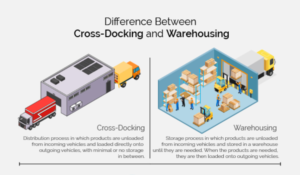
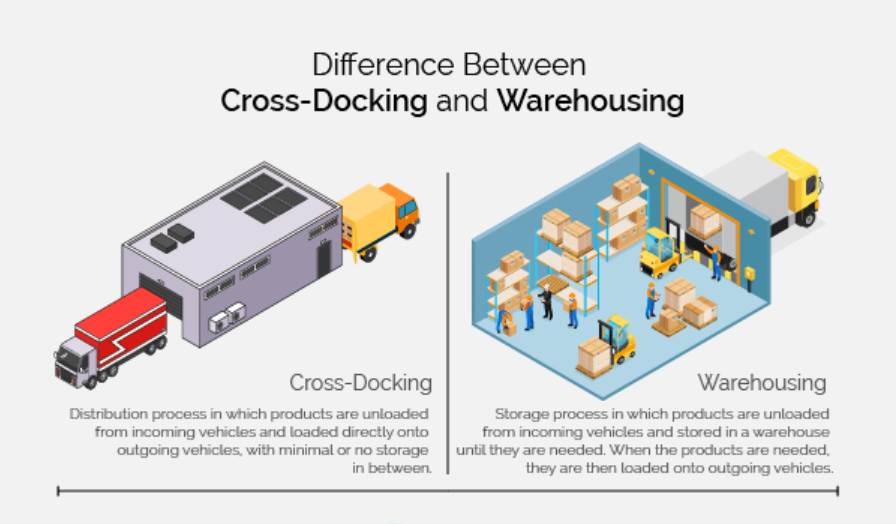
Cross-docking is a logistics process in which incoming freight is received at a facility and transferred to outbound transportation with little or no traditional warehouse storage. Instead of unloading products, putting them into storage locations, waiting for an order, picking them later, and then shipping them, a cross-docking operation keeps the freight moving through the facility.
The Lean Enterprise Institute describes a cross-dock as a facility that sorts and recombines inbound goods for outbound shipment, rather than functioning like a conventional warehouse.
Imagine a shipment arriving at a facility in Memphis with pallets destined for several customers across Tennessee, Arkansas, Mississippi, and neighboring markets.
Rather than putting every pallet onto warehouse racks, the operator unloads the freight, identifies the destination, moves the pallets to the appropriate outbound staging area, and loads them onto scheduled delivery vehicles. The facility functions more like a traffic interchange than a parking lot: freight enters, gets directed into the correct lane, and continues its journey.
The process can be particularly useful for high-turnover freight, retail replenishment, perishable products, time-sensitive shipments, and predictable distribution networks. Maersk notes that cross-docking can reduce storage and handling time and support faster movement from suppliers toward customers.
How Cross-Docking Works
A typical cross-docking operation starts before the truck reaches the facility. Inbound shipment information, destination requirements, pallet counts, delivery appointments, and outbound transportation schedules should be coordinated in advance.
When the freight arrives, workers unload it from the inbound vehicle and inspect or scan it as required. The shipment is then sorted, consolidated, or assigned to an outbound load before being transferred to another vehicle.
The exact process varies depending on the type of cross-docking operation. Some shipments may move almost directly from one dock door to another, while others may require brief staging or sorting.
Cross-docking can involve consolidation, where several smaller shipments are combined into a larger outbound load, or deconsolidation, where a larger inbound shipment is separated into smaller deliveries. These processes allow a facility to optimize transportation capacity without turning the freight into long-term inventory.
Timing is critical. Cross-docking works best when inbound arrivals and outbound departures are carefully synchronized. If a truck arrives several hours late or an outbound vehicle is unavailable, freight can accumulate on the dock and create congestion.
That is why successful cross-docking depends heavily on accurate shipment information, scheduling, dock management, communication, and reliable transportation partners.
What Is Transloading?
Transloading is the process of transferring freight from one transportation mode, vehicle, or equipment type to another so the shipment can continue toward its destination.
It is especially common in multimodal and international supply chains where freight cannot travel from origin to destination using one mode of transportation. For example, a container may arrive at a port by ocean vessel, move to a transloading facility, and then be transferred into domestic trucks for final distribution.
This is where the distinction in cross docking vs transloading becomes particularly important. Transloading is often driven by the need to change transportation equipment or mode. A container arriving from overseas may not be the most practical equipment for domestic distribution.
The cargo can therefore be unloaded from the international container, sorted or consolidated if necessary, and loaded into domestic trailers.
Transloading may also involve additional value-added services. Depending on the freight and supply chain, a facility may palletize products, repackage goods, consolidate multiple shipments, break down larger loads, label products, or prepare freight for its next transportation leg. Inbound Logistics describes transloading as particularly applicable to international shipments that travel through multiple transportation modes and notes that consolidation can reduce storage time and transportation costs.
How Transloading Works
A transloading operation begins when freight reaches a facility where a change in transportation equipment or mode is required. Consider an importer receiving a container shipment at a port. The container itself may not continue directly to every customer. Instead, the freight can be moved to a nearby facility, unloaded, sorted according to destination, and transferred into domestic trucks.
The process can become more complex when cargo requires special handling. Some freight may arrive floor-loaded rather than palletized, meaning workers must unload individual cartons and organize them before loading the outbound equipment.
Other shipments may require pallet exchange, labeling, wrapping, inspection, consolidation, or separation. The objective is not simply to move a box from one truck to another; it is to make the freight compatible with the next stage of the transportation network.
Transloading can therefore provide shippers with greater flexibility. Instead of designing an entire supply chain around a single transportation mode, companies can combine ocean, rail, and trucking networks according to cost, geography, capacity, and delivery requirements.
That flexibility is especially valuable for companies managing international freight, intermodal shipments, imports, exports, or distribution networks spanning large geographic areas.
Cross-Docking vs. Transloading: The Core Difference
The fundamental difference between cross-docking and transloading is the reason the freight is being transferred. Cross-docking focuses on rapid movement through a facility with minimal storage, often involving direct transfer between inbound and outbound trucks or shipments. Transloading focuses on changing the transportation method, equipment, or shipment configuration so freight can continue along the next part of its journey. Both can reduce the need for long-term warehousing, but their operational objectives are different.
Think of cross-docking as changing lanes on a highway and transloading as changing vehicles. If a truck arrives carrying pallets that already have their destinations established and those pallets simply need to move onto outbound trucks, the operation is primarily cross-docking. If a shipment arrives in an international ocean container and needs to be unloaded into domestic truck trailers, the operation is primarily transloading.
Transportation Mode
Transportation mode is one of the clearest ways to distinguish the two services. Cross-docking can happen without changing the fundamental transportation mode. For example, freight can move from an inbound truck to an outbound truck while remaining within the trucking network. The primary goal is faster distribution.
Transloading, by comparison, frequently involves a transportation-mode change. Freight may move from ocean to truck, rail to truck, truck to rail, or another combination depending on the supply chain. ATS describes transloading as the transfer of freight between different transportation modes, while cross-docking typically involves immediate transfer from one truck to another with little or no storage.
Freight Handling and Configuration
Another important difference is the amount and purpose of handling. Cross-docking generally tries to minimize handling because speed is a major objective. Freight may be unloaded, sorted, staged briefly, and loaded onto outbound equipment. The less unnecessary movement involved, the better.
Transloading can require more extensive handling because the freight may need to be adapted for its next transportation leg. A shipment could require palletizing, de-palletizing, consolidation, deconsolidation, repacking, labeling, or redistribution. That does not mean every transloading shipment requires extensive processing, but the possibility is part of what makes transloading more flexible than a straightforward cross-dock transfer.
Cross-Docking vs. Transloading: Side-by-Side Comparison
| Factor | Cross-Docking | Transloading |
|---|---|---|
| Primary purpose | Move freight quickly through a facility | Change transportation mode or equipment |
| Typical storage | Minimal or none | Usually limited, depending on operation |
| Transportation | Often truck-to-truck | Often ocean-to-truck, rail-to-truck, or other multimodal transfer |
| Handling | Usually minimal | Can include sorting, palletizing, repacking, or consolidation |
| Best for | Fast-moving, predictable distribution | Imports, exports, intermodal and multimodal freight |
| Main advantage | Speed and reduced storage | Flexibility and transportation optimization |
| Main challenge | Precise scheduling | Additional handling and coordination |
| Typical use | Regional distribution | Port, rail, international and multimodal logistics |
The comparison shows why neither service should automatically be considered better. The correct choice depends on the freight itself and what needs to happen next.
A shipper focused on fast regional distribution may gain more from cross-docking, while an importer moving ocean containers into domestic distribution may require transloading. In some supply chains, both services can even be used at different points.
Benefits of Cross-Docking
Cross-docking can reduce the amount of time freight spends sitting inside a facility. Traditional warehousing often requires receiving, put-away, storage, order picking, packing, and shipping.
Cross-docking can eliminate or significantly reduce several of these steps when the shipment is already organized for its next destination. That can make the supply chain faster and leaner, especially when freight volumes and delivery destinations are predictable.
The financial benefits can also be significant. Less storage can mean lower warehouse space requirements and reduced inventory holding expenses. Less repeated handling can reduce labor requirements and potentially lower the opportunity for damage caused by unnecessary movement. Cross-docking can also support transportation consolidation, helping shippers build more efficient outbound loads.
Faster Freight Movement
Speed is perhaps the biggest reason companies choose cross-docking. When products are already allocated to known destinations, they do not necessarily need to sit in inventory waiting for another processing cycle. Instead, the freight can move directly toward the customer.
This is particularly useful for products where timing affects value. Perishable goods, promotional merchandise, retail replenishment, and urgent replacement products can benefit from shorter dwell times. A logistics operation that saves hours at multiple points in the supply chain can create a meaningful difference in total delivery performance.
Cross-docking is not automatically fast, however. Poor scheduling can undermine the entire model. If inbound freight arrives before the outbound transportation is ready, the cross-dock can become congested.
If outbound trucks arrive before inbound freight is available, transportation assets may sit idle. The technology and operational discipline behind the process therefore matter just as much as the physical dock.
Lower Storage and Handling Costs
Cross-docking can reduce costs by minimizing traditional warehousing activities. Instead of paying for extended storage space and repeatedly handling inventory, companies can move products through a facility with much less dwell time.
A systematic literature review published in Sustainability identified reductions in warehousing, inventory-holding, handling, labor, and transportation costs among the potential benefits of an effective cross-docking strategy.
There is also an inventory benefit. When freight flows quickly from suppliers to customers, companies may be able to operate with leaner inventory levels in appropriate supply chains. That can reduce the amount of capital tied up in goods waiting inside a warehouse.
The tradeoff is that cross-docking requires excellent coordination. A conventional warehouse provides a buffer when supply and demand do not perfectly match. Cross-docking removes much of that buffer. For companies with unpredictable demand or unreliable inbound transportation, the reduction in storage can become a weakness rather than an advantage.
Benefits of Transloading
Transloading provides a different type of efficiency. Instead of primarily reducing handling and dwell time, it gives shippers the ability to connect different transportation networks. This can be especially valuable when international or intermodal freight needs to transition into domestic distribution.
Consider an importer receiving containers through a port. Ocean containers are designed for international transportation, but the importer may need to distribute products across the country using domestic trailers. A transloading facility creates the bridge between those two systems. The freight can be unloaded, organized, and transferred into equipment that is better suited for the next stage.
Transloading can also create opportunities for freight consolidation. Several inbound shipments can potentially be combined into efficient outbound loads, helping companies make better use of transportation capacity. In other cases, a large shipment can be divided into smaller regional deliveries. The flexibility is one of the strongest reasons businesses use transloading services.
Better Multimodal Flexibility
Modern supply chains rarely depend on one transportation mode from beginning to end. International cargo may move by ocean, rail, and truck before reaching its final customer. Domestic freight may travel by rail for the long-haul portion and then transfer to trucks for regional delivery. Transloading supports these transitions.
The ability to combine transportation modes can help businesses balance speed and cost. Rail may be attractive for certain long-distance freight movements, while trucking provides the flexibility needed for final-mile or regional delivery. Ocean transportation can efficiently move large quantities internationally, but domestic distribution often requires different equipment and routing.
Transloading makes these combinations possible without requiring the shipper to redesign its entire network around a single transportation method. That makes it especially useful for companies with complex distribution requirements.
Freight Consolidation and Reconfiguration
Transloading is also useful when freight needs to be reorganized before its next journey. A container may arrive with products intended for several destinations. Instead of sending the entire container to one location, a transloading facility can unload and separate the cargo according to distribution requirements.
The reverse can happen as well. Multiple smaller inbound shipments can be combined into larger outbound loads. This can improve trailer utilization and reduce the number of individual transportation movements required.
Additional services may also be performed during the transfer. Depending on the provider and freight type, these can include palletizing, stretch wrapping, labeling, sorting, inspection, and repackaging. The ability to combine transportation and handling services makes transloading particularly useful for complex freight networks.
When Should You Choose Cross-Docking?
Cross-docking is usually the stronger choice when your primary objective is speedy freight transfer with minimal storage. If your inbound freight is already organized, your destinations are predictable, and your outbound transportation can be scheduled reliably, cross-docking can create a highly efficient flow. It is particularly suitable for businesses that repeatedly move similar products through the same distribution network.
Retailers, distributors, manufacturers, e-commerce businesses, and companies handling time-sensitive products can all potentially benefit. The strategy is especially effective when demand is predictable enough that freight does not need to sit in inventory waiting for future orders. Maersk identifies retail, manufacturing, e-commerce, just-in-time operations, and time-sensitive products as areas where cross-docking can provide meaningful benefits.
Cross-docking can also make sense when you need to consolidate shipments. Suppose several suppliers send freight to a regional distribution point, and those shipments are all going to the same market. Rather than sending partially filled vehicles separately, a cross-dock can combine them into more efficient outbound loads.
The key question is simple: Does your freight mainly need to move faster, or does it need to change how it is transported? If the answer is faster movement with minimal processing, cross-docking deserves serious consideration.
When Should You Choose Transloading?
Transloading is generally more appropriate when freight needs to move between transportation modes or equipment types. If your supply chain includes ocean containers, railcars, domestic trailers, or other multimodal connections, transloading can provide the bridge between those systems.
It is particularly relevant for importers and exporters. International freight often enters a country in one form but needs to be distributed domestically in another. Transloading allows the shipment to transition into the equipment and transportation network best suited for its next destination.
You should also consider transloading when freight needs to be reconfigured. If products must be sorted by destination, consolidated into new loads, palletized, repackaged, or prepared for regional distribution, a transloading facility may offer more appropriate capabilities than a basic cross-dock.
The important point is that transloading is not simply “cross-docking with a different name.” The services may overlap, but the operational objective is different. A current industry comparison from WSI similarly emphasizes that cross-docking and transloading should be selected according to the actual logistics problem rather than treating one as universally superior.
Can Cross-Docking and Transloading Work Together?
Yes. In fact, a supply chain can use both processes at different stages. The idea that a shipment must be either cross-docked or transloaded from beginning to end is too restrictive. Logistics networks are often made up of multiple transfer points, and each point can use the method that best fits the freight and transportation requirement.
For example, an imported container could first be transloaded at a facility near a port. The products could be removed from the ocean container, palletized, sorted by destination, and loaded onto domestic trailers. When those trailers reach a regional distribution hub, the freight could then be cross-docked onto smaller outbound vehicles for final delivery.
This combination can create a highly efficient network. Transloading handles the equipment or transportation-mode transition, while cross-docking handles rapid regional distribution. Instead of forcing one process to do everything, the shipper uses each process where it creates the most value.
This is one reason understanding cross docking vs transloading is more useful than simply memorizing definitions. Real-world logistics is rarely black and white. The best supply chains connect multiple transportation and distribution strategies based on shipment characteristics, geography, customer requirements, and available capacity.
How to Choose the Right Freight Strategy
Start by identifying what physically needs to happen to the freight. Does the shipment simply need to move from an inbound vehicle to an outbound vehicle? Or does it need to move from an ocean container into a domestic trailer? Does it require sorting, palletizing, repackaging, consolidation, or another value-added service?
Next, evaluate your timing requirements. If the freight is highly time-sensitive and your inbound and outbound schedules are predictable, cross-docking may provide the fastest path. If the shipment has to transition between transportation modes, transloading may be unavoidable regardless of the required delivery timeline.
Cost should also be evaluated beyond the facility fee. Look at transportation costs, labor, storage, dwell time, handling, equipment utilization, potential damage exposure, and inventory carrying costs. A service that appears more expensive at the dock may produce a lower total landed logistics cost when the entire transportation network is considered.
Finally, evaluate the capabilities of your logistics provider. A strong provider should understand your freight characteristics, appointment requirements, equipment needs, handling procedures, and destination network. The right facility is not simply a building with loading docks; it needs the processes, labor, equipment, technology, and transportation coordination necessary to execute your freight strategy reliably.
A practical decision framework looks like this:
| Your primary requirement | Likely solution |
|---|---|
| Move freight rapidly between trucks | Cross-docking |
| Change from ocean container to domestic truck | Transloading |
| Transfer rail freight to trucks | Transloading |
| Consolidate shipments for rapid outbound delivery | Cross-docking or transloading, depending on the process |
| Repackage or palletize imported freight | Transloading |
| Minimize warehouse storage for known destinations | Cross-docking |
| Support complex multimodal logistics | Transloading |
| Rapid regional redistribution | Cross-docking |
There is no universal winner in the cross docking vs transloading debate. The correct strategy depends on the specific movement your freight needs to make. Industry guidance published in 2026 continues to make the same practical distinction: cross-docking emphasizes fast transfer and minimal dwell, while transloading emphasizes transportation-mode or equipment changes and can include additional freight handling.
Conclusion
Understanding cross docking vs transloading comes down to understanding the job each process is designed to perform. Cross-docking is primarily a rapid-flow strategy: freight arrives, is sorted or consolidated as necessary, and moves quickly onto outbound transportation with minimal storage.
Transloading is primarily a transportation-transition strategy: freight moves from one mode or equipment type to another and may be sorted, consolidated, palletized, repackaged, or otherwise prepared for the next stage.
For shippers focused on fast regional distribution, predictable freight flows, and lean inventory, cross-docking can reduce unnecessary storage and handling while improving shipment velocity.
For importers, exporters, intermodal operators, and businesses moving freight across different transportation networks, transloading can provide the flexibility needed to connect those modes efficiently. Neither option is automatically better; the right choice depends on the freight, transportation network, delivery requirements, and handling needs.
The most effective logistics strategy may also use both. A shipment can be transloaded when it changes transportation equipment and then cross-docked later when it enters a regional distribution network. Once you understand the difference, you can stop treating these terms as interchangeable and start evaluating them based on the actual problem your supply chain needs to solve.
FAQs
1. What is the main difference between cross-docking and transloading?
The main difference is the purpose of the transfer. Cross-docking focuses on moving freight rapidly from inbound to outbound transportation with minimal storage. Transloading focuses on transferring freight between transportation modes or equipment types and may involve additional handling such as sorting, palletizing, consolidation, or repackaging.
2. Is transloading faster than cross-docking?
Not necessarily. Cross-docking is specifically designed for rapid freight movement and minimal dwell time, so it can be faster when shipments are already organized and outbound transportation is synchronized. Transloading may take longer when freight requires additional handling, but it provides capabilities that a simple cross-dock transfer may not offer.
3. Can a shipment be both transloaded and cross-docked?
Yes. A shipment can be transloaded at one facility to change from an international container into domestic transportation and later cross-docked at another facility for rapid regional distribution. Using both strategies can create an efficient end-to-end supply chain.
4. Which service is better for imported freight?
Transloading is often the more appropriate choice for imported freight when goods arrive in ocean containers and need to be transferred into domestic trailers or another transportation network. It can also support palletizing, sorting, consolidation, and other preparation required for domestic distribution.
5. How do I know whether my freight needs cross-docking or transloading?
Start with the next step in your shipment’s journey. If the freight mainly needs to move quickly from one inbound truck to an outbound truck with little or no storage, cross-docking may be appropriate. If the freight needs to change transportation modes, equipment, packaging, or shipment configuration, transloading is more likely to be the right solution. A logistics provider can evaluate the shipment’s origin, destination, equipment, volume, timing, and handling requirements before recommending the best approach.